In critical pipeline infrastructure—spanning municipal water transmission, offshore hydrocarbons, and chemical processing—unidirectional flow assurance is non-negotiable. Non Return Valves (NRV) perform this fundamental safety function 24/7 without external electrical or pneumatic power.
The Physics Behind Non-Return Valve Mechanisms
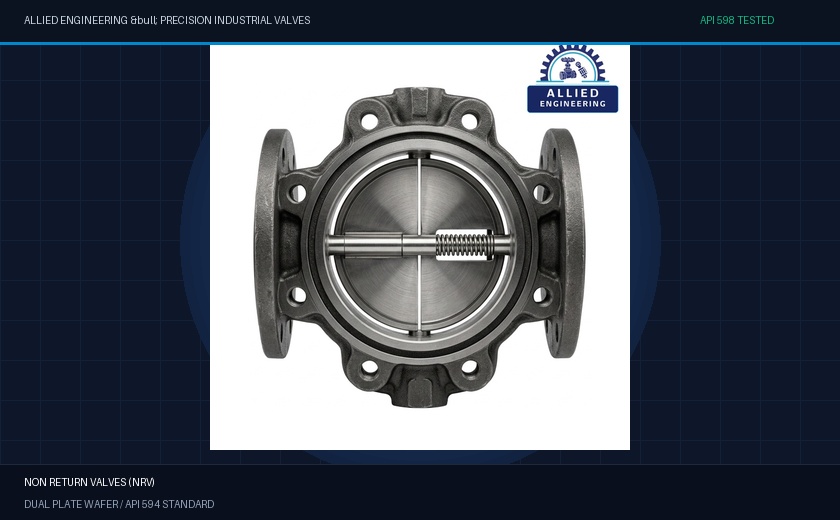
An NRV functions as a hydraulic diode. The valve’s internal seat geometry and closure element create an asymmetric flow boundary: forward pressure creates an opening force vector, while reverse pressure magnifies the sealing contact force against the elastomer or Stellite seating face.
Comparative Analysis: Wafer Dual-Plate vs. Conventional Swing Check
| Design Factor | Dual-Plate Wafer NRV (API 594) | Conventional Flanged Swing Check (BS 1868) |
|---|---|---|
| Weight & Footprint | 80% lighter; 75% shorter face-to-face | Heavy, bulky cast body requiring extended support |
| Water Hammer Resistance | Superior; torsion springs snap plates shut prior to zero velocity | Moderate; long travel distance can cause slam on rapid flow stoppage |
| Installation Flexibility | Vertical flow up or horizontal line orientation | Primarily horizontal lines; vertical requires upward flow only |
| Maintenance & Parts | Fewer moving components; quick in-line servicing | Hinge pin and disc bushing require periodic greasing/inspection |
Primary Industrial Applications
Allied Engineering manufactures heavy-duty NRVs serving severe operating environments worldwide:
- Refinery Hydrocracking & Alkylation Units: Preventing explosive hydrocarbon cross-contamination between high and low-pressure stages.
- Power Station Condensate & Boiler Feedwater: Guarding multi-stage boiler feed pumps against superheated steam back-flash.
- Desalination & Sea Water Reverse Osmosis (SWRO): Super duplex and Ni-Al Bronze check valves resisting aggressive chloride pitting.
Preventive Maintenance & Inspection Checklist
To guarantee zero-leakage performance throughout the valve’s design life, Allied Engineering recommends:
- Inspect hinge pins and spring tension every 12 months for scale buildup or stress corrosion cracking.
- Check resilient seats (Viton, EPDM, PTFE) for swelling or extrusion in aggressive solvent lines.
- Perform acoustic leak detection during operational shutdowns to catch internal seat weeping early.