In modern industrial fluid handling, reverse flow is one of the most destructive phenomena a piping engineer can encounter. Without automatic safeguards, fluid returning under head pressure can spin pumps backward, blow out compressor seals, and trigger devastating hydraulic water hammer shocks. The solution is the Check Valve (also known as a Non-Return Valve or NRV).
How Does a Check Valve Work?
Unlike manual ball, gate, or globe valves that require handwheel or actuator intervention, check valves are self-actuating automatic valves. They rely solely on the line pressure and flow velocity of the moving media to operate.
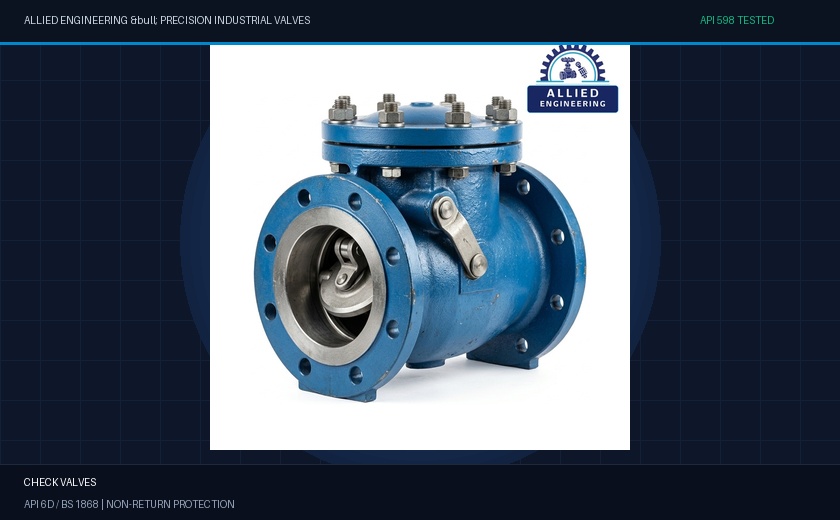
When fluid flows in the forward direction, its dynamic pressure overcomes the valve’s cracking pressure and internal spring resistance, lifting the disc off its seat. As forward velocity diminishes or begins to reverse, gravity, spring tension, and downstream backpressure instantly force the closure member back against the seat, sealing the line before backflow can build destructive momentum.
Critical Protection • Pump & Compressor Longevity
Check valves are universally positioned immediately downstream of centrifugal pumps and positive displacement compressors. In the event of a sudden power outage, the check valve closes instantaneously, shielding expensive rotating machinery from destructive reverse spin.
Common Industrial Check Valve Types
Different operating conditions require specific check valve architectures:
- Swing Check Valves (BS 1868 / API 6D): Features a hinged disc that swings freely on a pivot pin. Offers a straight-through, full-bore flow area with the lowest pressure drop among check valves. Ideal for continuous, uninterrupted liquid pipelines.
- Dual-Plate Wafer Check Valves (API 594): Utilizes two semi-circular spring-loaded plates pinned vertically. Extremely lightweight and compact, it fits between standard ANSI flanges and closes within milliseconds to prevent surge shock.
- Lift Check Valves: The disc moves vertically up and down in a guided chamber similar to a globe valve body. Suited for high-pressure steam, air, and gas services with rapid cycling.
- Non-Slam Piston Check Valves: Features an integrated hydraulic dampening chamber (dashpot) that cushions disc descent, eliminating slamming noise and pressure waves in reciprocating pump systems.
Key Selection Criteria
Selecting the appropriate check valve involves calculating key hydrodynamic factors:
- Minimum Flow Velocity: The media velocity must be sufficient to hold the disc in a stable, fully open position without fluttering against the seat.
- Cracking Pressure: The minimum upstream differential pressure required to initiate flow.
- Response Time: Fast-closing spring-assisted plates minimize reverse flow velocity before seat contact, mitigating water hammer.