When engineering an industrial piping isometric, one of the most frequent specification decisions is choosing between a Quarter-Turn Ball Valve and a Multi-Turn Gate Valve. Both are premier isolation valves, yet their mechanical differences dictate drastically different operational outcomes.
Working Principle Comparison
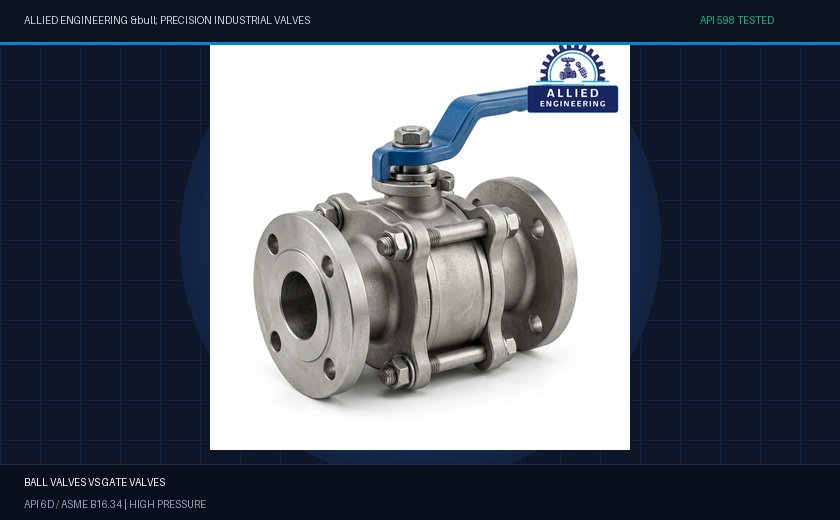
A Ball Valve employs a spherical bore positioned inside soft or metal seats. A 90-degree stem rotation moves the ball from full-open to full-shut. This quarter-turn mechanism provides rapid emergency shutoff and clean visual indication of valve status.
In contrast, a Gate Valve uses a wedge-shaped gate that travels perpendicularly across the fluid streamline via a threaded stem. Multiple handwheel revolutions are required to raise or lower the wedge, ensuring gradual flow stoppage that naturally guards against hydraulic water hammer in high-mass liquid pipelines.
Design Rule of Thumb
For fast-acting isolation, tight bubble shutoff, and automated actuation, choose Ball Valves. For high-temperature steam, large-diameter pipelines (DN300+), and applications where zero flow restriction is prioritized over cycle speed, specify Gate Valves.
Engineering Comparison Matrix
| Characteristic | Allied Industrial Ball Valve | Allied Cast/Forged Gate Valve |
|---|---|---|
| Operation Cycle | Quarter-Turn (90° rotation, < 2 seconds) | Multi-Turn (15-40 turns, gradual closure) |
| Sealing Capability | Bi-directional, bubble-tight (API 598 Class VI) | Tight metal-to-metal shutoff (API 600) |
| Actuation Readiness | Extremely simple mounting via ISO 5211 pads | Requires high-torque multi-turn electric gearboxes |
| Cavity Trapping | Body cavity relief holes required for cryogenic/gas service | Self-relieving wedge or flexible wedge options available |
| Cost Efficiency | Highly economical up to 6″; heavier beyond 12″ | Most cost-effective choice for 8″ to 48″ high-pressure headers |